人生如茶: The Portable Temple
功夫茶 (Gōngfū Chá, Skilful Tea) as Contemplative Resistance to the Chaotic Profane
A Multimedia Research Project by Jordan O'Malley
Originally developed as a Fall 2025 academic seminar research project.
Institution: McMaster University, Faculty of Social Sciences

Abstract
When the world offers no sanctuary, how is sacrality found in a simple gesture? Perhaps quiet ritual is the only rebellion left.
In a world of hyper-connection, digital acceleration, and perpetual stress, many live trapped within an unexamined "default setting." As the late author and essayist David Foster Wallace describes, this state is one of "unconsciousness" and "constant, gnawing" anxiety. However, this state is not merely psychological; it is structural. We exist within an "economy of attention-extraction," where the dominance of data and technological control erodes lived, embodied cultures of dwelling, relationship, and ritual.
This project proposes that a deceptively simple act—the making of tea—can serve as a radical form of resistance to this extraction. The micro-ritual of 功夫茶 (Gōngfū Chá, Skilful Tea) functions as a modern contemplative technology—a portable temple—that allows practitioners to sacralise profane space.
The Architecture of the Portable Temple
In the Spadina Station underpass, the air is thick with the friction of transit. Commuters rush past the ghost of a moving walkway removed decades ago, ignoring the now-useless "PLEASE HOLD HANDRAIL" instructions still carved into the walls. Amidst this utilitarian decay and linear rushing, a small table is set. Steam rises from a 蓋碗 (gàiwǎn; lit. lidded bowl), unbothered by the schedule of the next train.
Tea is not merely a beverage; historically, it has been a vehicle for meditation and ethical cultivation. Chan monks in China integrated tea drinking into their daily lives as a sanctioned drug to fuel meditation. Monastic codes (Qīngguī) meticulously structured this drinking, highlighting tea-making as a deliberate, embodied ritual.
In defining this portable temple, we operationalise Jonathan Z. Smith’s theory of place. Smith argues that the sacred is not an inherent quality of a location, but a "situational category" created by human labour. By setting up the tea table in the Spadina underpass, we are not searching for a sacred spot; we are manufacturing one. The tea table acts as a "focusing lens," marking and revealing significance amidst the visual noise of the subway.
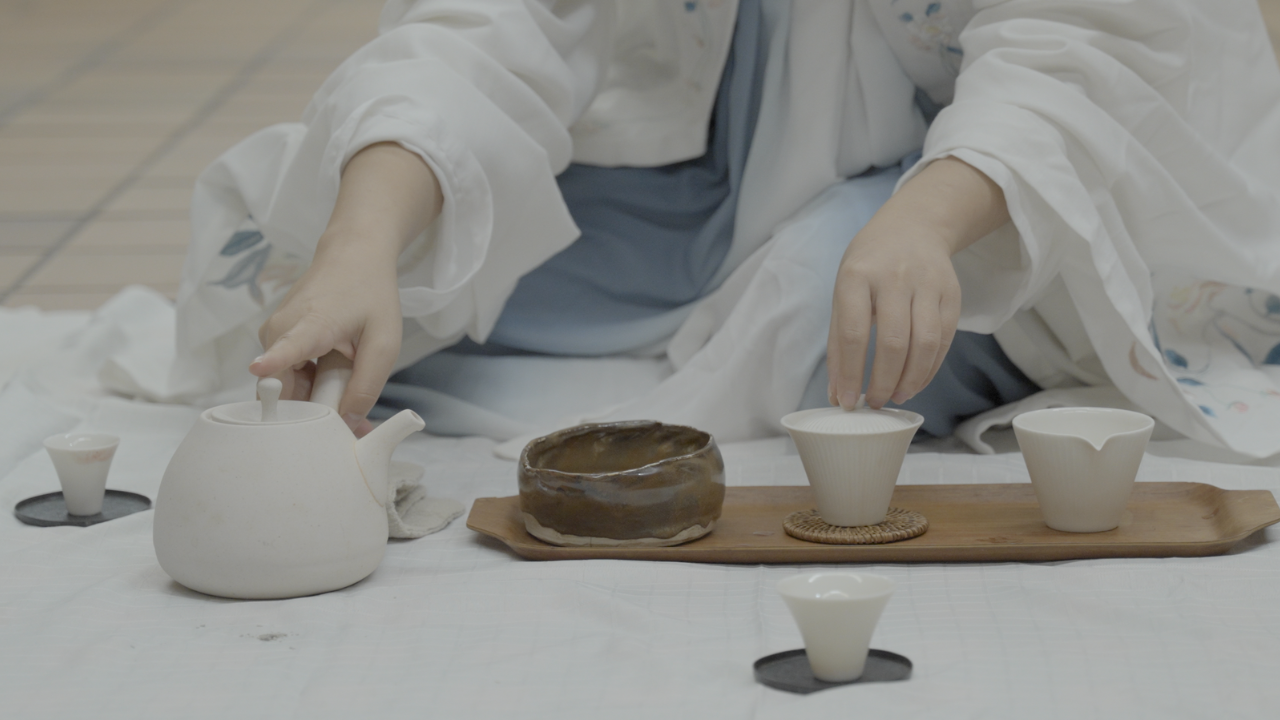
This re-organisation of ordinary life is achieved through specific material agents, where formal features are constitutive of meaning:
The Tea Tray (茶盤, Chá Pán): This defines the boundary (界限, jièxiàn) of the portable sacred space. By physically containing the overflow of water, it symbolically disciplines the chaos of the external world.
The Crucible (蓋碗, Gàiwǎn): The vessel serves as a crucible of transformation. Handling it requires fine motor skills and a fixed gaze, enacting a forced mindfulness that overrides the anxiety of the modern nervous system.
The Fairness Pitcher (公道杯, Gōngdào Bēi): Embodying balance (平衡, pínghéng), this is the most critical philosophical tool. By pooling the tea before it is served, it acts as a physical delay mechanism, offering a ritualised counter-gesture to impulsivity and the demand for instant gratification.
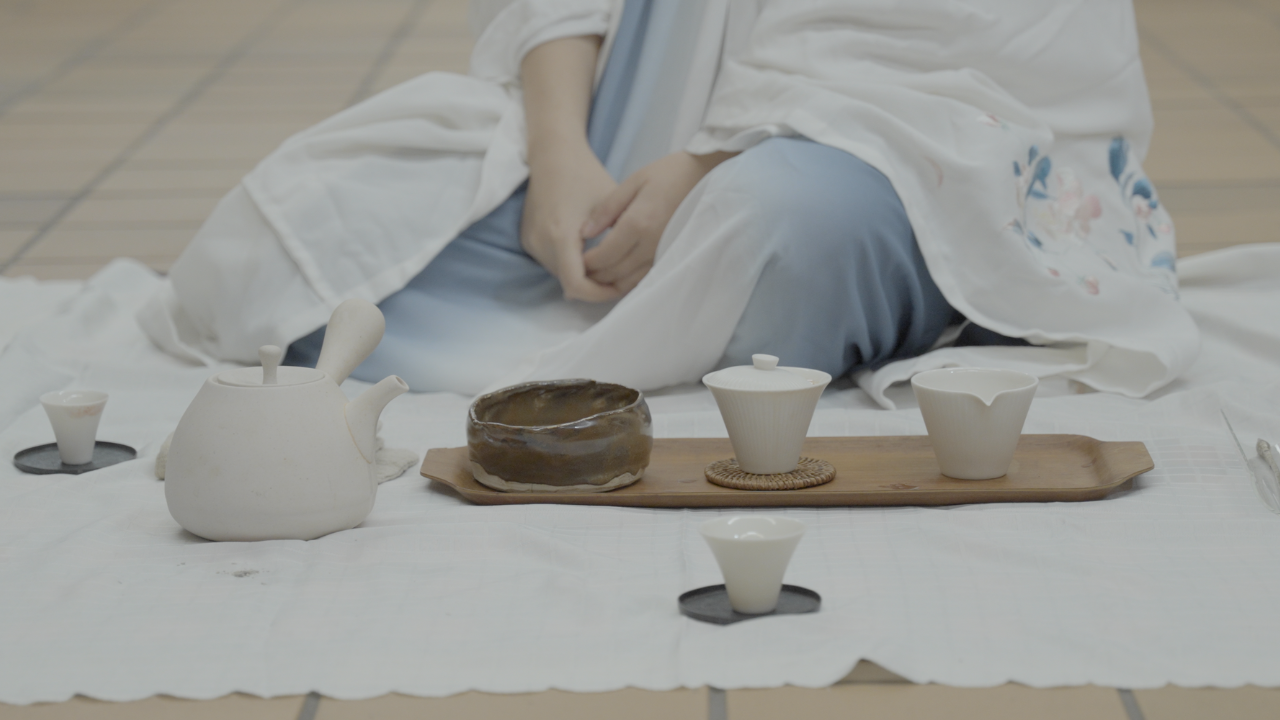
Filmic Juxtaposition: The Efficacy-Entertainment Braid
A critique often levelled at filmed or staged rituals is that they move from the realm of authentic religion into mere theatre—that by setting up a camera, the "sacred" is lost to the "spectacular." However, this project deliberately inhabits what performance theorist Richard Schechner defines as the "efficacy-entertainment braid."
The film production—the lights, the camera, the public setting—constitutes the "entertainment" frame, inviting the subway commuters to look and watch. But inside that frame, the Gōngfū Chá ceremony maintains its "efficacy": it is a disciplined technology of self-cultivation intended to produce results.
Furthermore, the camera itself serves a liturgical function. In the open chaos of the Spadina Station underpass, the camera frame becomes an enclosure. However, unlike physical walls, this camera-boundary is porous. The "staging" makes the boundary visible, but the reality of the subway crowd makes it permeable, allowing the calmness of the ritual to leak out and the chaos of the city to seep in.
When a commuter pauses to cross the boundary and accept a cup of tea, the ritual moves from personal cultivation to a social negotiation of space. It demonstrates that sacralised practice generates relational depth within, not despite, the chaos of the profane.
Conclusion
人生如茶 (Rén Shēng Rú Chá) is not a metaphor realized in thought but an insight enacted in practice. The Gōngfū Chá ritual provides a structured, intentional re-formation of the self. The portable temple is built through skill and presence, enacted anew with every cup—a sanctuary crafted in a world that offers none.
Glossary of Key Terms
人生如茶 (Rén Shēng Rú Chá): Life is like tea. The central philosophical proverb/allegory.
功夫茶 (Gōngfū Chá): Skilful Tea. The precise, deliberate Chinese tea preparation ritual.
公道杯 (Gōngdào Bēi): Fairness Pitcher. Vessel for balancing tea; symbolises balance and delay.
修身養性 (Xiūshēn Yǎngxìng): Cultivating the body, nourishing the nature. The concept of self-cultivation through disciplined practice.
沉時坦然,浮時淡然 (Chén Shí Tǎnrán, Fú Shí Dànrán): Calm when sinking, indifferent when floating. The ethical posture of acceptance.
Project Credits
Conceptual Framework, Research, & Writing: Jordan O'Malley
Direction & Production: Jordan O'Malley
Original Score ("茶道"): Canadian Calm Collective (O’Malley & Delchuk)
Videography & Colour Grading: Aaron Chu
Tea Master Performance: Sabrina Chen
Location: Spadina Station Underpass, Toronto
Further Reading
Benn, James A. (2015).Tea in China: A Religious and Cultural History. Honolulu: University of Hawaiʻi Press.
Schechner, Richard. (1988).Performance Theory. New York: Routledge.
Smith, Jonathan Z. (1987).To Take Place: Toward Theory in Ritual. Chicago: University of Chicago Press.
Wallace, David Foster. (2009).This Is Water. New York: Little, Brown and Company.